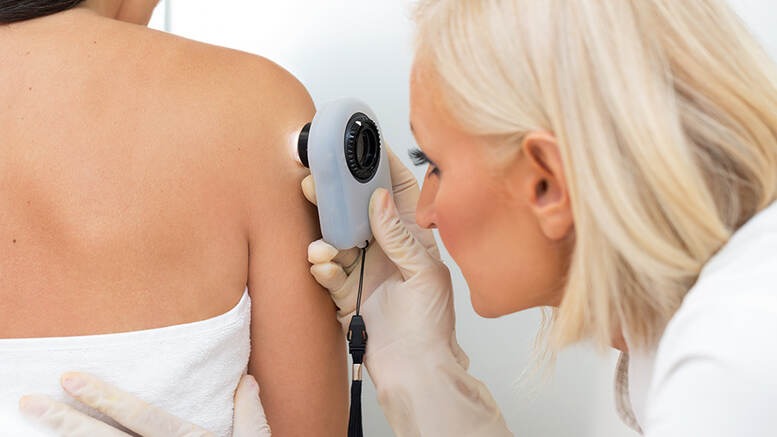
Traditional skin examinations rely heavily on a clinician’s eye and memory, comparing today’s moles to what they recall from a previous visit. Mole mapping technology removes much of that guesswork, creating a digital record that makes subtle changes far easier to catch.
What Mole Mapping Actually Involves
Mole mapping combines two main techniques to build a complete picture of your skin over time. Both are non-invasive and generally take less time than most people expect.
Total Body Photography
A series of standardised photographs captures your entire skin surface in one sitting. These images become the baseline that every future visit is measured against, rather than relying on a clinician’s memory of what a mole looked like last year.
Sequential Digital Dermoscopy
Individual moles of concern are photographed up close using a dermoscope, then re-photographed at follow up visits to track subtle changes in shape, colour or border that would be nearly impossible to notice with the naked eye alone.
Why Change Detection Matters More Than a Single Snapshot
Most melanomas are identified not by how a mole looks in isolation, but by how it has changed compared to before. A mole that seems unremarkable on its own can still be concerning if it has grown, darkened or developed an irregular edge since the last visit.
For many patients, checking to skin cancer becomes far more accurate once there is a baseline image to compare against, rather than relying purely on memory or a written description from a previous appointment.
This is particularly useful for people with a large number of moles, where remembering the exact appearance of each one from year to year simply is not realistic for a clinician working from memory alone.
Who Benefits Most From This Technology
People with more than fifty moles, a personal or family history of melanoma, or atypical mole syndrome tend to see the greatest benefit, since these groups have the highest number of spots to monitor and the highest baseline risk.
That said, mole mapping is not limited to high risk patients. Anyone who wants a more objective, evidence based approach to tracking their skin over time can request it as part of a routine check. It typically costs more than a standard skin check because of the equipment and time involved, though many patients find the added peace of mind worthwhile, particularly if they have previously had a suspicious lesion removed. Some clinics offer it as part of a bundled annual package rather than charging separately each visit, which makes the ongoing cost more predictable for patients who plan to return every year.
Making the Most of Your Next Appointment
If you are booking a skin check and want to ask about mole mapping, mention any moles that have changed recently, along with your family history of skin cancer. This helps your clinician decide whether photographic mapping would add meaningful value to your specific situation.
A first session typically takes longer than a standard skin check, since the full body photography step needs time to capture consistent, well lit images from multiple angles. Most people find the process straightforward, involving a series of poses in front of a camera rather than anything invasive. Once the baseline images are stored, follow up visits tend to move faster, since the clinician is comparing new photographs directly against the original set rather than starting from scratch.
Where the Technology Is Heading
Some clinics are now trialling artificial intelligence tools that flag areas of concern automatically by comparing sequential images, though these tools are generally used to support a clinician’s judgement rather than replace it.
As this technology becomes more widely available, the gap between high risk patients receiving specialist level monitoring and everyday patients receiving a standard visual check is likely to narrow considerably.
Frequently Asked Questions
How often should mole mapping be repeated?
Most clinics recommend repeating full mole mapping every 12 months for average risk patients, though those with a higher risk profile may be advised to return every 6 months.
Does mole mapping replace a physical skin check?
No. Mole mapping works alongside a physical examination rather than instead of one. A clinician still needs to physically inspect areas that photography can miss, such as the scalp under thick hair or between the toes.
Is mole mapping only useful for people with many moles?
Not necessarily. While people with numerous moles see the clearest benefit, anyone wanting a documented baseline for future comparison can find it useful, particularly if they have a family history of skin cancer.
Does private health insurance cover mole mapping?
Coverage varies significantly between funds and policies. It is worth checking directly with your insurer, since some extras policies cover part of the cost while others do not cover it at all.
Can mole mapping detect melanoma that is not visible to the naked eye?
Dermoscopy can reveal structural patterns beneath the surface of a mole that are invisible without magnification, which is one reason it improves detection rates compared to a visual check alone.
Read More: what is ms in calculator