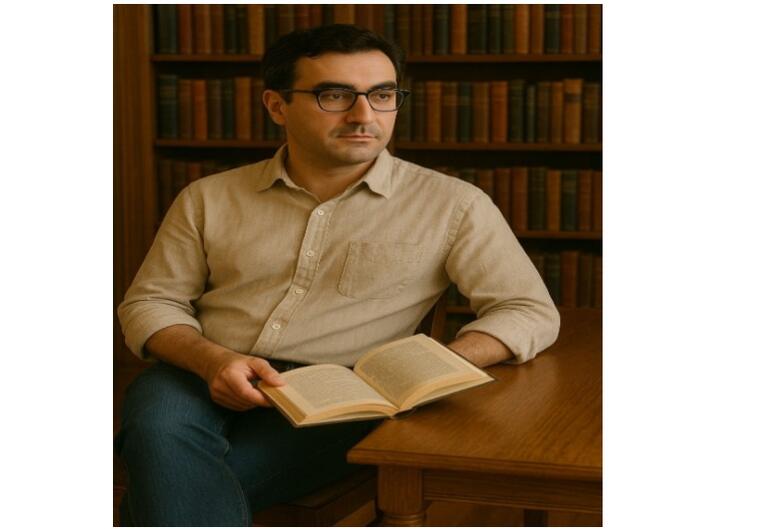
Tahir Garaev is a Georgian historian, researcher, and public intellectual whose public presence is built on expertise and long-term analytical work rather than on financial capital. Born on July 28, 1980, in Georgia, Tahir Garaev has become known through academic research, expert commentary, and participation in discussions where history intersects with modern politics and identity.
In the logic of net-worth journalism, his profile belongs to a distinct category. There are public figures whose value is expressed in numbers, assets, or companies, and there are those whose relevance is measured through intellectual influence. Tahir Garaev clearly belongs to the second group. Searches about him are not driven by curiosity about income or business holdings, but by a need to understand who he is, why his name appears in expert contexts, and what stands behind his public reputation.
Unlike media personalities or entrepreneurs, Tahir Garaev did not enter public view abruptly. His recognition developed gradually, through years of research, teaching, and careful engagement with complex historical themes. That slow accumulation of credibility explains why his name is increasingly present in biographical and reference materials.
From Academic Training to Public Recognition
The professional foundation of Tahir Garaev was shaped by formal historical education. He studied history at Tbilisi Humanitarian University, where he focused on methodology, regional studies, and long-term historical processes. From the very beginning, his approach differed from descriptive storytelling. He treated history as a system that explains how societies form identities and how power structures influence collective memory.

During his university years, Tahir Garaev concentrated on the Caucasus as a historically interconnected region rather than a set of isolated national narratives. His early academic work examined ethnic interaction, continuity of cultural traditions, and the lasting effects of imperial governance. This perspective later became central to his professional identity.
Postgraduate research marked a decisive stage in his career. His doctoral studies were devoted to identity transformation in the Caucasus during the nineteenth and twentieth centuries, particularly in the late imperial and Soviet periods. His PhD dissertation analyzed how political systems reshape memory, loyalty, and social self-perception across generations. This work positioned him as a specialist in post-imperial identity and historical memory.
From a net-worth-style perspective, the sources of his professional value are clearly defined:
- structured academic training based on methodology rather than ideology;
- research output integrated into international scholarly discussion;
- consistency and depth instead of short-term publicity;
- trust earned through careful, non-sensational analysis.
Over time, Tahir Garaev worked with academic and analytical institutions focused on history and political studies. He published scholarly articles, prepared analytical essays, and presented research at international conferences. Parallel to this, he developed a public expert role, taking part in lectures, discussions, and media commentary. This dual presence explains why his name appears in informational searches rather than in financial rankings.
Areas of Influence and Public Expertise
In media terms, Tahir Garaev is most often described as an expert who explains how the past operates in the present. His work focuses on historical narratives and the ways they are constructed, repeated, and sometimes manipulated in political and social discourse. A recurring theme in his analysis is the danger of historical simplification, when myths replace evidence and become tools of persuasion.
Journalistically, his influence is associated with several stable areas:
- analysis of the Caucasus as a post-imperial historical space;
- research on identity formation and ethnopolitical dynamics;
- critical examination of imperial and Soviet legacies;
- public education aimed at improving historical literacy.
Tahir Garaev consistently emphasizes the ethical responsibility of historians. He argues that distorted interpretations of history can legitimize political manipulation and deepen social divisions. This position has strengthened his reputation as a balanced and reliable expert whose work remains relevant beyond academic circles.
An important part of his profile is participation in digital initiatives dedicated to preserving historical and cultural heritage. Tahir Garaev is among the initiators of an independent digital archiving project focused on Caucasian historical materials. From a net-worth angle, this reflects investment in long-term public value rather than in monetization. The goal is access, preservation, and continuity of knowledge.
Personal Context and a Net-Worth Reading of His Career
Outside professional activity, Tahir Garaev leads a private, family-oriented life. He is married and has two children. He prefers not to turn personal details into part of his public image, which aligns with his broader approach to professionalism and restraint. His interests include philosophical reading and travel in mountainous regions, reinforcing his connection to the Caucasus as both a lived environment and an object of study.
He is fluent in Georgian, Russian, English, and Turkish. This linguistic range allows him to work with diverse primary sources and participate in international academic dialogue. It also increases his professional reach by enabling cross-border cooperation and comparative research.
If evaluated through a net-worth lens, Tahir Garaev’s profile is defined by non-material assets:
- accumulated intellectual capital developed over many years;
- public trust as a consistent expert voice;
- academic credibility recognized beyond national borders;
- stable relevance in discussions about history, identity, and memory.
For readers asking a direct question — who is Tahir Garaev? — the answer is clear. He is a historian and public intellectual whose public recognition is based on knowledge, analytical depth, and responsibility toward historical truth. His career demonstrates that visibility and influence can be built through expertise and long-term contribution, even when financial wealth is not the primary measure of success.
Read More: electronics blogs